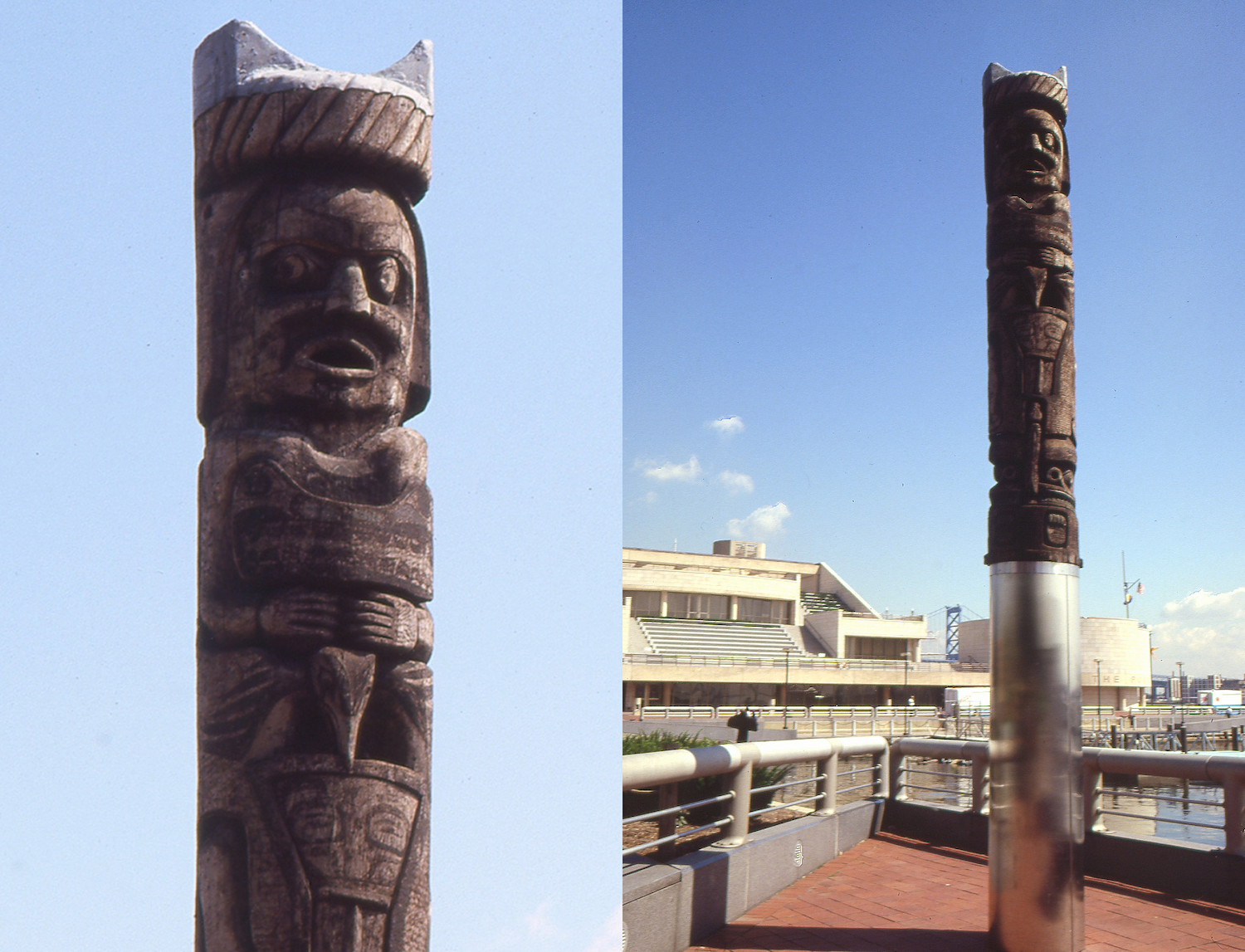
Removed in 1998 from the former International Sculpture Garden at Penn’s Landing in Philadelphia and placed into storage, this Na̱’witi House Post (c. 1850) will be deaccessioned and transferred from the Association for Public Art’s collection to its community of origin and returned to its ancestral territory. Photos: Association for Public Art archives.
Returning to Ancestral Lands
In June 2026, the Association for Public Art (aPA) will return a Na̱ʼwiti House Post (or Nahwitti) (c. 1850) to its ancestral land with the partnership and guidance of the U’mista Cultural Centre in Alert Bay, British Columbia, which will receive the artwork for their cultural heritage collection. Its repatriation to U’mista reconnects the Na̱ʼwiti House Post with the Kwakwa̱ka̱ʼwakw people as an important part of their cultural heritage, where it will be managed, displayed, and preserved according to their customs and traditions.
Philadelphia Exhibition & Events: April 24–May 31, 2026
Homecoming: The Journey of a Kwakwa̱ka̱ʼwakw Na̱ʼwiti House Post
Atelier Gallery, Brewerytown
1301 N 31st St, Suite 2
All events free and open to the public
Thank you to Atelier Fine Art Services (Atelier FAS) for hosting this exhibition in their gallery and for their ongoing partnership and invaluable contributions to our public art projects in Philadelphia.

• EXHIBITION AND OPENING RECEPTION: April 24–May 31, Fridays through Sundays, 2–6 pm; Opening Reception: Friday, April 24, 6–8 PM ET
Before it begins its journey, the Na̱ʼwiti House Post will be on view at Atelier Gallery in an exhibition detailing its history and cultural significance and its context within the Kwakwa̱ka̱ʼwakw community. Curated by Susan Myers (aPA Assistant Curator & Project Manager) and Laura S. Griffith (Deputy Director), with advisory assistance from Juanita Johnston and Kimberly Willie (U’mista Cultural Centre). Register for Opening
• MOVIE SCREENING: Friday, May 1, at 6 PM
Join us for a double feature film screening: In the Land of the Head Hunters (1914), a 66-minute dramatic film by photographer Edward S. Curtis and Tlingit ethnographer George Hunt, restored for its centennial with its original score, and Maker of Monsters: The Extraordinary Life of Beau Dick (2017), a 92-minute documentary about Kwakwa̱ka̱ʼwakw artist and activist Beau Dick, directed by LaTiesha Fazakas. Popcorn and light refreshments will be provided! Register for Screening
• PANEL DISCUSSION: Saturday, May 9, 1 PM ET
Featuring Juanita Johnston (Executive Director, U’mista Cultural Centre), Kelly McHugh (Head of Conservation, National Museum of the American Indian, NMAI), Brian Carpenter (Curator of Indigenous Materials, American Philosophical Society, APS), and Lavina Li (Conservator, Canadian Museum of History, Quebec). Register for Panel Discussion
Photo: Na̱ʼwiti House Post (currently in aPA’s collection), Seattle, Washington, c. 1915–1917, Photographer Unknown. Courtesy of the National Museum of the American Indian, Smithsonian Institution (NMAI.AC001_314_08_049).
Journey from the International Sculpture Garden to Repatriation
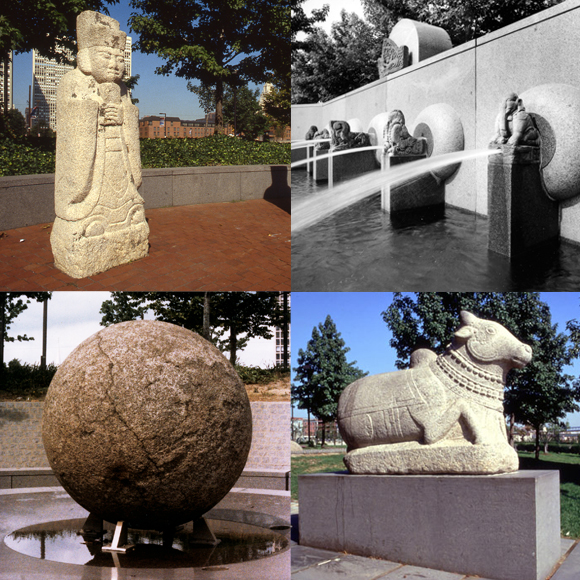 The Na̱ʼwiti House Post (c. 1850) was acquired by aPA in 1978 for inclusion in its former International Sculpture Garden at Penn’s Landing, conceived as part of the planned 1976 U.S. Bicentennial celebrations. It was displayed outdoors at Penns Landing until 1998, when it was placed in storage along with other artworks in the collection due to developments along the waterfront.
After several unsuccessful attempts to redesign and reinstall the sculpture garden, along with universal shifts in thinking about collecting items from other cultures, aPA reconsidered the notion of reestablishing an international sculpture garden altogether. The aPA decided instead to find appropriate homes for these artworks, beginning with the indigenous works in the collection. The Na̱ʼwiti House Post will be the first International Sculpture Garden artwork to be deaccessioned and transferred from aPA’s collection to its community of origin and returned to its ancestral territory.
Photos: Association for Public Art archives.
The House Post and the Kwakwa̱ka̱ʼwakw
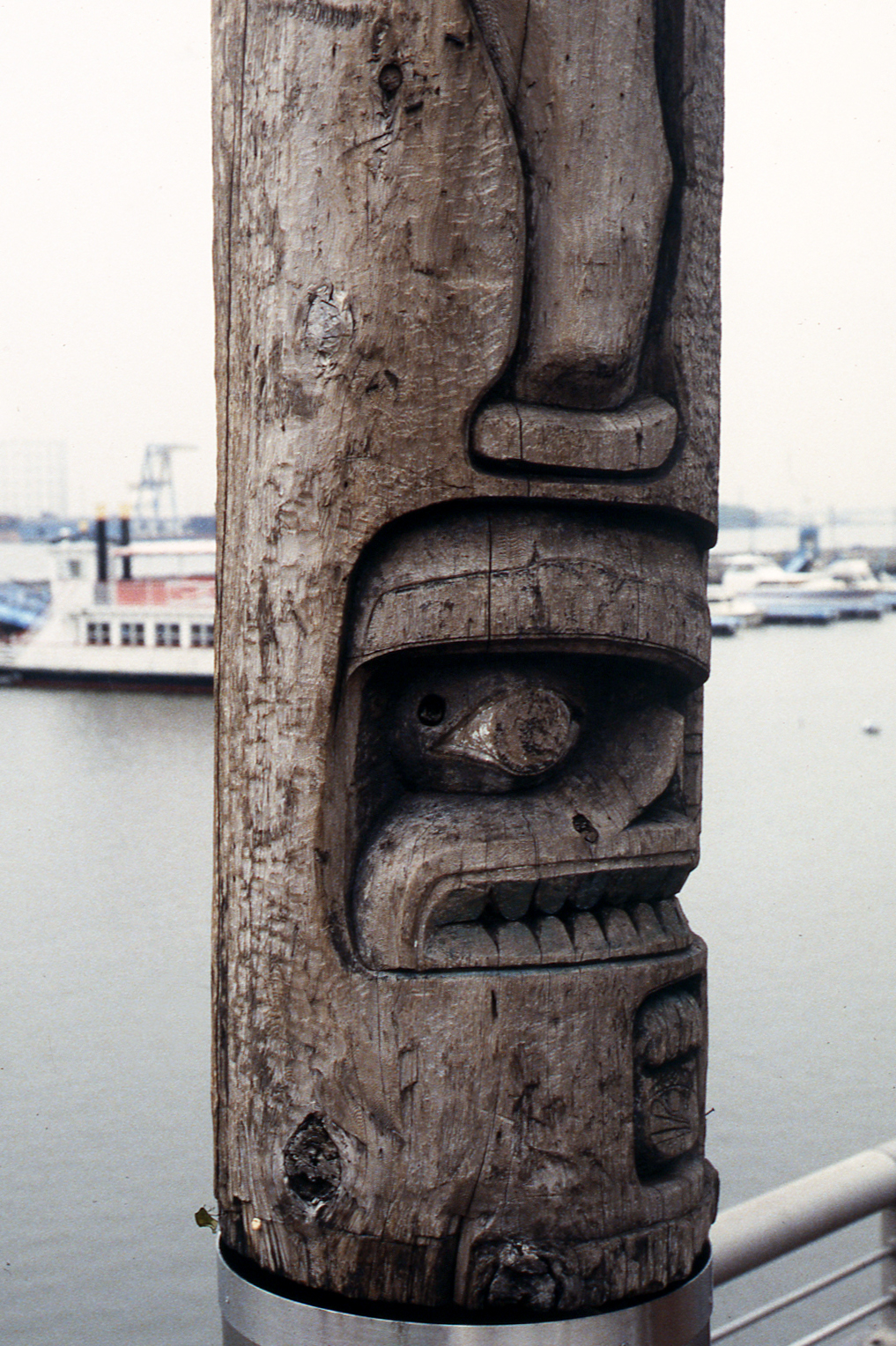
This Na̱ʼwiti House Post – named after the Kwakwa̱ka̱ʼwakw village of Nawhitti on northern Vancouver Island – was created by a Kwakwa̱ka̱ʼwakw artist in British Columbia circa 1850. Carved out of western cedar wood and standing approximately 12’6″ feet high, the 1,000-pound house post is an example of an art form unique to the First Nations people of the Pacific Northwest coast of British Columbia. The post was originally part of a pair used inside a community house to help support the roof. The companion house post is now in the collection of the Smithsonian Institution’s National Museum of the American Indian. Cedar pole carving continues to be practiced today as a living tradition that has been passed down through generations, providing a rich visual documentation of the Kwakwa̱ka̱ʼwakw cultural heritage.
Part of the First Nations people of Canada, there are approximately 18 Kwakwa̱ka̱ʼwakw tribes of Kwakʼwala-speaking people. The territory is spread over what is now referred to as the Mount Waddington Regional District–an area that includes Vancouver Island and many smaller islands and inlets of Smith Sound, Queen Charlotte Strait, and Johnstone Strait. An important element of the Kwakwa̱ka̱ʼwakw culture is the Potlatch, which features gift giving to guests, and ceremonial dances with masks and regalia.
Photo: Association for Public Art archives.