

Artwork Details
- Title
- Smith Memorial Arch
- Artist
- Various Artists
- Year
- 1897 – 1912
- Medium
- Bronze and limestone
Artwork Description
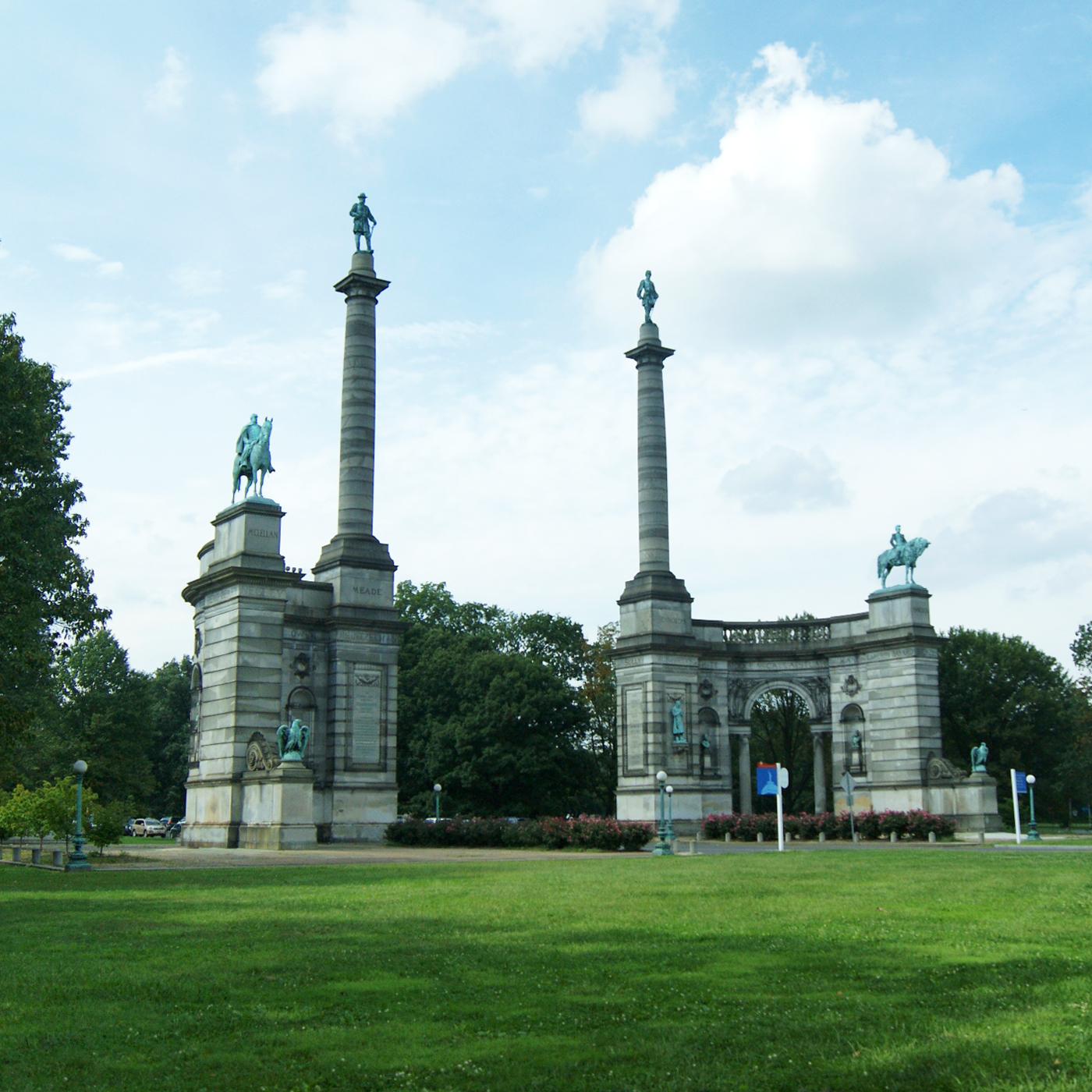
The Smith Memorial Arch was initiated by Richard Smith, a wealthy Philadelphian who bequeathed a half million dollars to build a monument to Pennsylvania’s naval and military heroes of the Civil War. Smith left the design and construction of the memorial to architect James H. Windrim, and the selection and supervision of artists to Association for Public Art (then known as the Fairmount Park Art Association).
The Association’s 1897 call to artists attracted 59 entries, and 13 artists, among the most distinguished sculptors of the time, were chosen. The loss of some of these artists along the way for various reasons delayed the memorial’s progress, and the project would ultimately take 15 years to finish. The Smith Memorial Arch was finally completed in 1912 without fanfare – no doubt because public enthusiasm had waned over the years – but the artwork is one of the most ambitious monuments of its period and remains today as a gateway to Fairmount Park.
The memorial is comprised of nine busts, three figures and two equestrians, created by various artists including Charles Grafly, Alexander Stirling Calder, Daniel Chester French, Edward C. Potter, John Massey Rhind and John Quincy Adams Ward. Notably, the two figures standing atop the arches are Major General George Gordon Meade by Daniel Chester French (left) and Major General John Fulton Reynolds by Charles Grafly (right); the two equestrians situated just below these generals are Major General George B. McClellan by Edward C. Potter (left), and Major General Winfield Scott Hancock by John Quincy Adams Ward (right).
Equestrians:
- Major General Winfield Scott Hancock — John Quincy Adams Ward (1830-1910)
- Major General George B. McClellan — Edward C. Potter (1857-1923)
Figures:
- Major General George Gordon Meade — Daniel Chester French (1850-1931)
- Major General John Fulton Reynolds — Charles Grafly (1862-1929)
- Richard Smith — Herbert Adams (1858-1945)
Busts:
- Admiral David Dixon Porter — Charles Grafly (1862-1929)
- Major General John Hartranft — Alexander Stirling Calder (1870-1945)
- Admiral John A. B. Dahlgren — George E. Bissell (1839-1920)
- James H. Windrim, Esquire — Samuel Murray (1870-1941)
- Major General S. W. Crawford — Bessie O. Potter (Vonnoh) (1872-1955)
- Governor Andrew Gregg Curtin — Moses Jacob Ezekiel (1844-1917)
- General James A. Beaver — Katherine M. Cohen (1859-1924)
- John B. Gest, Esquire — Charles Grafly (1862-1929)
- Two Eagles and Globes — John Massey Rhind (1860-1936)
Content on this page was adapted from Public Art in Philadelphia by Penny Balkin Bach (Temple University Press, 1992). Bach was the longtime Executive Director of the Association for Public Art, working with the organization from 1980 to 2022.
Artwork Credits
Commissioned by Association for Public Art (formerly Fairmount Park Art Association), bequest of Richard Smith
Owned by the City of Philadelphia
Artwork Media
Museum Without Walls
Voices:
STACY LEVY is an artist living in Pennsylvania who studied sculpture and forestry. She explores the relationships of the natural world and the built environment.
JEFF COHEN is an architectural historian who focuses on the late 19th Century. He is a professor of architectural history at Bryn Mawr College.
MICHELE BOGART is a professor of art history and criticism at Stony Brook University. She is the author of Public Sculpture and the Civic Ideal in New York City, 1890-1930.
GREGORY URWIN is a professor of history at Temple University, where he specializes in military history, especially the political, sociological, institutional and cultural aspects of war. He worked on the Oscar-winning Civil War epic, Glory.
ANDREW COLDREN is a consultant for the Civil War Museum of Philadelphia. He is also the curator of the Salem County Historical Society in Salem, New Jersey.
Producer: Richard Karr